
A brand storytelling website needs a clear point of view, credible material and a useful next step. Its story should help a visitor understand what the business stands for and why its offer might suit them.
Start with something specific. “We make choosing your everyday coffee feel approachable” gives a writer, photographer and developer a shared direction. A general ambition to feel premium or memorable leaves many more decisions unresolved.
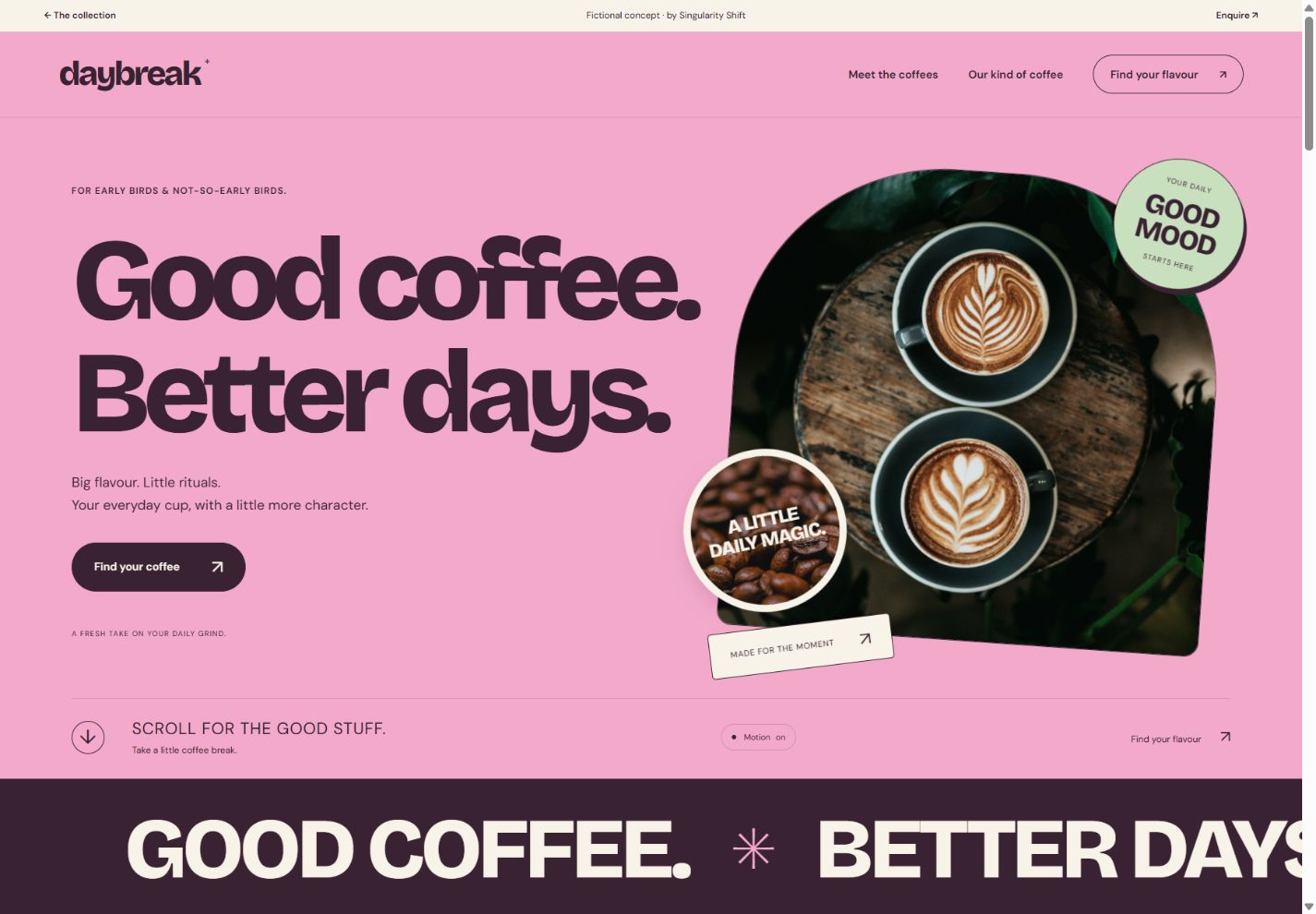
The DAYBREAK concept offers a working example. It is a fictional independent coffee brand, so its narrative is an invented creative direction. It demonstrates how a point of view can connect words, photography, movement and product discovery without claiming a real founder history or customer results.
See the idea in action
DAYBREAK
Explore layered coffee imagery, a flavour finder and a personal tasting list.
Original concepts for fictional brands, created by Singularity Shift.
Find the idea the business can own
A story does not have to begin with the founder's childhood or a long company timeline. It can begin with the customer's situation, the way something is made or a clear belief that shapes the offer.
For a hypothetical Cheltenham maker, the interesting idea might be helping people choose an object they will enjoy using every day. Evidence could include the maker's material choices, photographs of prototypes and the reasoning behind a particular detail.
Write one sentence describing the idea. Then identify what supports it. If the sentence promises personal attention, the service process should explain how that happens. If it centres on craftsmanship, show the relevant work and describe who does it.
Where a claim cannot yet be supported, reconsider the claim. Strong presentation should make the available evidence easier to understand.
Build a sequence with a purpose for each scene
DAYBREAK's opening introduces the tone through large typography, a playful colour palette and coffee photography. The next photographic sequence moves through beans, a cup and a shared coffee moment. The finder then invites visitors to choose their own flavour preference.
There is a simple progression: introduce the mood, give it a recognisable setting, then let the visitor participate. The decorative elements and functional controls relate to the same idea of an approachable daily ritual.
You can plan a similar sequence on paper. For each section, finish the sentence “After this, the visitor understands…” If two adjacent sections answer the same question, combine them or give one a different job.
A service business might explain a familiar problem, show how its approach addresses it and present a relevant example. A product brand might introduce the object, reveal a useful detail and let visitors compare options. The sequence should follow what someone needs to understand.
Make the visitor's action part of the story
An interaction earns its place when it develops the idea. In DAYBREAK, choosing between chocolatey, bright and decaf preferences makes the visitor's own routine part of the experience. The recommendation then explains a coffee in relation to that choice.
Consider what someone could usefully do on your site. They might inspect a material detail, compare two legitimate options or choose the kind of work they want to see. The result should provide information, not merely trigger another flourish.
Keep a direct route available too. DAYBREAK links to its finder from the opening section. Visitors who already know their task can get there without completing the photographic story.
For a local business, the next step may be visiting a showroom or discussing a commission. That practical destination belongs in the narrative from the beginning. It should not appear as an unrelated contact button after a long presentation.
Give movement an editorial role
DAYBREAK's opening photograph, lettering and stickers move at different depths. Its oversized text tracks travel in opposite directions with scrolling. In the coffee sequence, photographs overlap while the background colour changes.
Those effects establish pace and emphasise transitions. They also have an off state: the page includes a motion control, responds to a system reduced-motion preference and presents the story as static photographs when appropriate.
This is worth specifying in the brief. The W3C guidance on animation from interactions explains the importance of allowing non-essential movement to be disabled. A reduced-motion version should retain the meaning and the route through the content.
Ask to review the still version as well as the moving one. If the story disappears when movement is removed, the words or structure need more work. The guides to parallax design and animation accessibility cover those choices separately.
Prepare a small, purposeful content set
Before commissioning a long scrolling page, gather material for a short sequence. Useful ingredients include a concise introduction, a few photographs with distinct roles, a process detail and a clear description of the visitor's next action.
For each photograph, record what it depicts, who owns it and what it contributes. A close-up may explain texture; a wider image may establish setting. Repeating several attractive but similar images can slow the story without adding information. The photography and art direction guide can help plan that selection.
Review the draft with someone unfamiliar with the business. Ask what they think you offer, which detail they remember and what they would do next. Their answers are more useful at this stage than a general vote on whether the page looks impressive.
For website design in Cheltenham, I can help shape a clear story around your actual business and material. Bring the idea you want people to understand, along with the photographs, work or product details that support it.